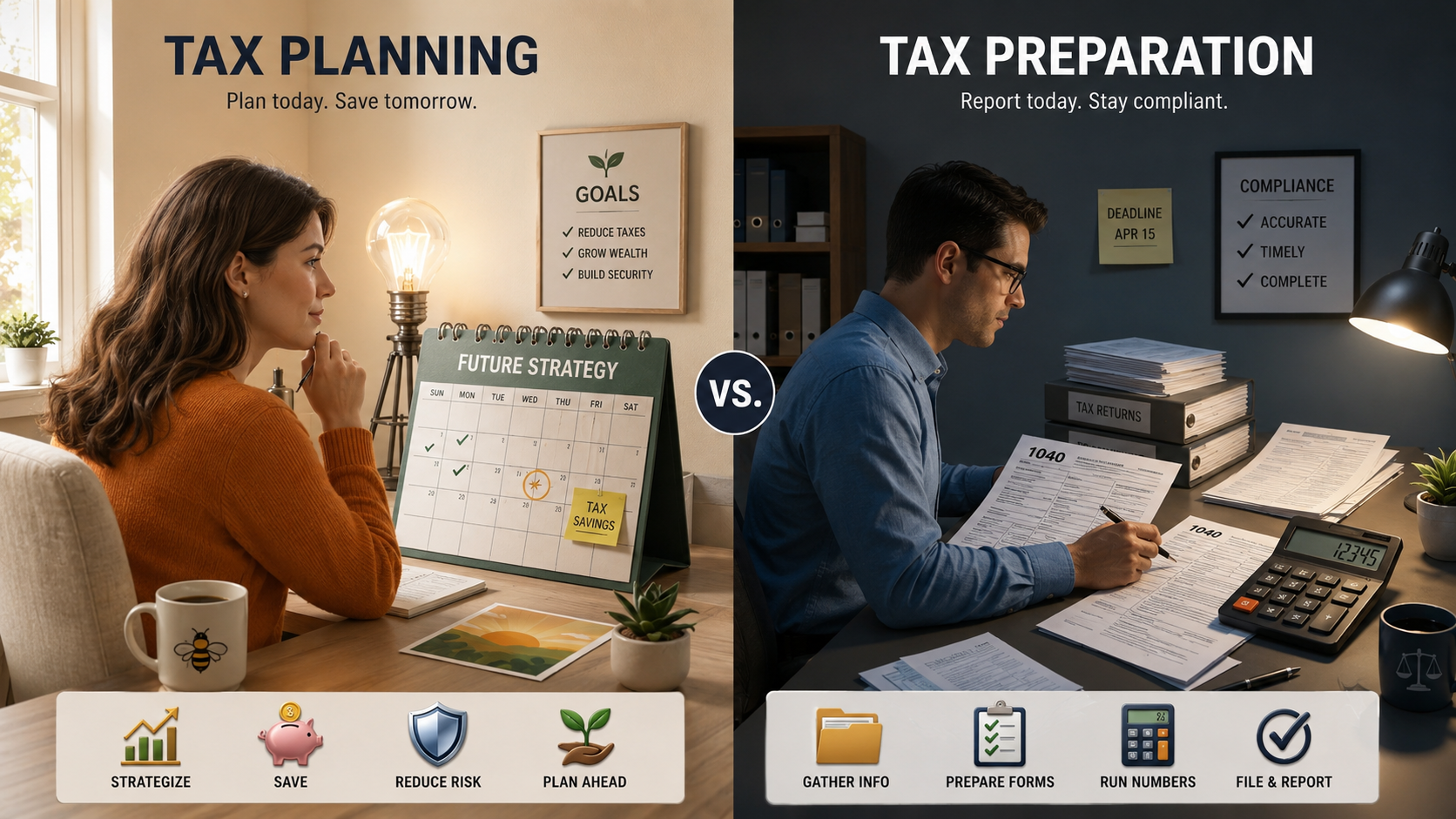
Many business owners think about taxes only during filing season. This backward-looking approach fulfills your legal obligations but does not fund future growth. Understanding the difference between tax planning vs tax preparation changes your entire financial trajectory.
Tax preparation focuses on reporting past financial activity to ensure legal compliance. Proactive tax planning looks forward to implementing strategic decisions that reduce your long-term tax liability.
What Is Tax Preparation?
Tax preparation is the process of gathering financial information, completing tax forms, and filing tax returns. The primary goal of tax return preparation is absolute accuracy and strict tax compliance. It serves as a historical record of what your business already accomplished during the prior year.
A standard tax return preparation engagement involves specific transactional tasks. Your professional focus remains fixed on federal, state, and local tax deadlines.
- Reviewing financial data: Analyzing historical income and business expenses to ensure accurate reporting.
- Applying current codes: Claiming standard deductions and credits that are readily available on the surface.
- Form completion: Documenting business activity on required corporate tax filing paperwork.
This process is necessary to avoid costly filing errors and government penalties. However, tax preparation vs tax strategy is ultimately a reactive exercise. It records past events but cannot change how much money left your business treasury.
What Is Tax Planning?
Tax planning is the process of making proactive financial decisions throughout the year to reduce tax liability and improve long-term outcomes. Instead of waiting until tax season, year-round tax planning helps business owners evaluate choices before they execute them. This consistent review turns your tax bill into a controllable variable rather than an unavoidable shock.
A dedicated tax strategist looks at your business through a forward-looking lens. They evaluate how daily operational choices impact your total small business taxes.
- Optimizing entity structure: Evaluating your corporate setup to unlock the highest tax savings strategies.
- Timing major moves: Accelerating or deferring business expenses and revenue to maximize deductions and credits.
- Structuring quarterly obligations: Planning estimated tax payments accurately to protect your liquid cash flow management.
This proactive tax planning connects your tax obligations directly to your overarching business tax strategy. It ensures you do not accidentally lock in negative tax consequences.
Tax Planning vs Tax Preparation: Key Differences
To build a healthy business, you must treat these two functions as distinct tools. They operate on different timelines and produce completely different results for small business taxes.
| Feature | Tax Preparation | Tax Planning |
| Primary Focus | Filing accurate tax returns | Developing business tax strategy |
| Timeline | Occurs during traditional tax season | Happens consistently throughout the year |
| Core Objective | Achieving baseline tax compliance | Minimizing total long-term tax liability |
| Financial Direction | Looks backward at completed activity | Looks forward at financial forecasting |
While every business needs tax preparation, tax planning and preparation yield the highest return when combined. Relying on filing alone leaves your hardest-earned revenue vulnerable.
Why Tax Preparation Alone Is Not Enough for Business Owners
Relying solely on year-end tax preparation creates a massive blind spot for small business taxes. By the time your accountant sits down to prepare your return, the financial year is locked. You cannot retroactively change your entity structure or implement advanced tax savings strategies after December thirty-first.
Business owners who skip proactive tax planning regularly face painful financial consequences. They suffer through unexpected tax bills that drain operational cash reserves. They also miss valuable deduction opportunities because their transactions were not structured correctly.
Compliance keeps you out of trouble, but it does not fund your future growth. Without forward-looking strategy, you are simply paying more than the law requires.
Why Tax Planning Is More Strategic
Tax planning connects taxes to the broader financial health of your business. A strong tax planning process reduces your total tax liability while freeing up capital to improve cash flow management. It allows you to make better hiring and investment choices because you understand exactly how business decisions affect taxes.
This level of guidance functions as a core component of financial strategy rather than an isolated administrative service. It turns numbers into an active road map for growth.
How Tax Planning and Tax Preparation Work Together
Tax planning and tax preparation should not be separate, disconnected services. The best tax outcomes happen when tax preparation is supported by accurate books and proactive planning throughout the year.
A complete accounting model moves through four distinct stages to protect your profits. Each step builds directly upon the previous one.
- Accurate bookkeeping: Keeps your daily financial records completely organized and ready for analysis.
- Reliable accounting: Provides transparent financial reporting so you can monitor real profit margins.
- Strategic planning: Evaluates that reporting to discover legal paths to reduce your tax liability.
- Seamless preparation: Files clean, optimized returns that reflect your intentional planning choices.
When these pieces work together, you gain absolute clarity over your cash flow management. Your tax strategy finally aligns with your active business growth.
When Should Business Owners Start Tax Planning?
You do not need to wait for tax season to seek a higher level of guidance. Certain business milestones require immediate, proactive tax planning to protect your margins.
- Rapidly increasing revenue: When profits spike, your baseline tax liability jumps significantly.
- Shifting operational costs: Significant changes in business expenses require a recalculation of your estimated tax payments.
- Expanding the workforce: Hiring employees or independent contractors introduces complex new compliance rules.
- Capital investments: Planning major equipment purchases requires careful timing to maximize deductions and credits.
The absolute best time to speak with a tax strategist is before you make these decisions. Waiting until the transaction is complete removes your ability to optimize the financial outcome.
Common Mistakes Business Owners Make
Many business owners fall into predictable traps when managing their small business taxes. The most common mistake is assuming that standard tax preparation naturally includes proactive tax strategy. Most traditional firms are too overwhelmed by tax deadlines to offer deep advisory support during peak season.
Another frequent error is making major corporate purchases without analyzing the structural tax impact. Similarly, choosing a financial professional based entirely on the lowest filing cost usually backfires. A cheap return can cost you thousands of dollars in missed deductions and credits.
Investing in a proactive partner eliminates these costly blind spots. You shift from a position of anxiety to a position of control.
How Rise CPA & Accountants Supports Tax Planning and Preparation
At Rise CPA & Accountants, tax support is part of a broader financial strategy for business owners. Our team helps businesses connect tax planning, tax preparation, accounting, bookkeeping, and advisory support so financial decisions are based on accurate, up-to-date information.
Rather than treating taxes as a once-a-year task, Rise helps business owners take a proactive approach to tax strategy, compliance, and long-term financial clarity. We support business-focused tax preparation while helping clients identify opportunities for proactive planning.
Move Beyond Reactive Tax Filing with Rise CPA & Accountants
Tax planning helps businesses make proactive decisions that can reduce tax liability and improve financial outcomes.
If your business is ready to move beyond reactive tax filing, working with a proactive financial partner can help you build a smarter tax strategy.